8.30.2005

Black-throated Blue Warbler


Yesterday before work I checked Pheasant Branch Conservancy for more fall migrants. I wasn't surprised at all to find a couple of my birding friends, Aaron Stutz and Steve Theissen with the same plan. Aaron and I got really nice close-up looks at a still brilliantly plumaged CANADA WARBLER.

After Aaron left for work, Steve found a female BLACK-THROATED BLUE WARBLER (one of my favorite birds) that we admired. Not as many individual birds as there were on Saturday, but birding reports from the north indicate that much more is yet to come through.

I've only managed to obtain one photograph of a male Black-throated Blue Warbler, but it makes a better quiz photo than pretty portraiture! So, here's a nice shot of a male at a nest from USF&WS.

Black-throated Blue Warblers nest in Wisconsin, but only in the northernmost part. Here's a map from the Wisconsin Bird Breeding Atlas indicating their nesting activity.

Link: All about the Black-throated Blue Warbler from Cornell Labs

Black-throated Blue Warbler image courtesy of US Fish & Wildlife Service

8.28.2005

Monitoring Bird Migration via NEXRAD


It's 5:00AM and I've just checked NEXRAD to see how much bird migration has occurred through the night. The image above shows NEXRAD Base Reflectivity from the La Crosse station from just a few minutes ago. Once again there is moderate migration so I'll probably check Governor Nelson State Park or Pheasant Branch Conservancy later this morning to see what has come in.

To use this NEXRAD website, select the "0.5d reflectivity" under product and then select a NEXRAD station from the US map. Under "Loop duration" you can animate the progression of migration throughout the night, or over several hours. When looking at the National NEXRAD map you can view the extent of migration throughout the entire country.

For a great primer on how bird migration and NEXRAD work, check out John Idzikowski's "Bird Migration and Movements on NEXRAD Doppler Radar From Wisconsin and the Western Great Lakes" website.

Link: Using Doppler Radar to Save Songbirds

8.27.2005

MAS Field Trip to Pheasant Branch - Results!


(click on image for larger version)

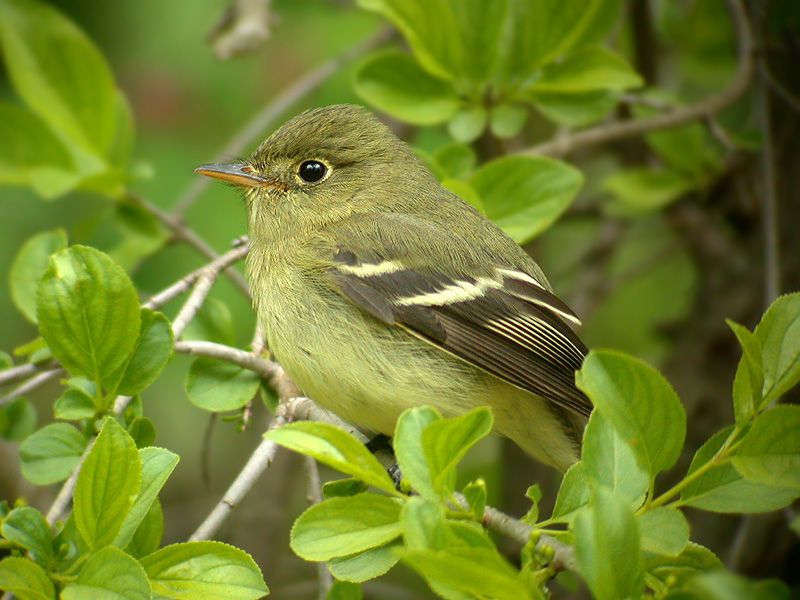
About 20 participants enjoyed the gorgeous weather and great birding during this morning's Madison Audubon field trip into Pheasant Branch Conservancy. Some of the birds were difficult to spot through the leaves but we still tallied nearly a dozen warbler species, including GOLDEN-WINGED WARBLER and CANADA WARBLER. Other uncommon gems included an OLIVE-SIDED FLYCATCHER and a YELLOW-BELLIED FLYCATCHER. When I woke up this morning and checked NexRad I figured the birds would be plentiful. Thanks to everyone who came and made the field trip a success!

Here's the complete species list...

Pheasant Branch Conservancy (Middleton) - August 27th, 2005:

Red-tailed Hawk
Ring-billed Gull
Ruby-throated Hummingbird
Red-bellied Woodpecker
Downy Woodpecker
Olive-sided Flycatcher
Eastern Wood-Pewee
Yellow-bellied Flycatcher
Great Crested Flycatcher
Red-eyed Vireo
Blue Jay
American Crow
Barn Swallow
Black-capped Chickadee
Tufted Titmouse
White-breasted Nuthatch
House Wren
Blue-gray Gnatcatcher
American Robin
Gray Catbird
Cedar Waxwing
Blue-winged Warbler
Golden-winged Warbler
Tennessee Warbler
Chestnut-sided Warbler
Magnolia Warbler
Black-throated Green Warbler
Blackburnian Warbler
Bay-breasted Warbler
Black-and-white Warbler
American Redstart
Canada Warbler
Northern Cardinal
Baltimore Oriole
American Goldfinch

Yellow-bellied Flycatcher image © 2005 Michael Allen McDowell

8.26.2005

Mark Pretti Nature tours


Mark Pretti, professional nature guide, recently sent me an email with a few positive comments on my blog, so I thought I would return the compliment and give him a little personal endorsement!

If you ever plan a birding trip to Southeast Arizona, consider employing Mark's services as a nature guide. When I went to the Southwest Wings Birding Festival back in 2003, I went on one of Mark's field trips into Ramsey Canyon and it was one of the finest birding experiences I've ever had. We tallied 77 species in just a few hours with birds like Hepatic Tanager, Canyon Wren, Arizona Woodpecker, Acorn Woodpecker, Band-tailed Pigeon, Sulphur-bellied Flycatcher, Lucifer Hummingbird and more.

Mark's intimate knowledge of nature encompasses the entire flora and fauna of the area and isn't limited to birds, as he'll point out plants, insects, mammals and reptiles along the way. I think it's also great that he offers environmental education programs to students and children of all age groups. For a complete list of Mark's programs, tours and field trips you can visit his website.

Ramsey Canyon image © 2005 Michael Allen McDowell

8.25.2005

Jean Iron's Digiscoping


From the Digiscoping Desk...

Jean Iron is a digiscoper from Ontario, Canada who has accumulated an impressive gallery of digiscoped images (especially shorebirds) using her Swarovski ST80 HD spotting scope and Nikon Coolpix 4500. It was an Eagle Optics customer who gave me the tip to check out her website. While her bird pictures are fantastic, I especially like the James Bay habitat shots she has included to give one a sense for the large expanses nesting shorebirds require.

Jean also provides detailed instructions on her digiscoping ring that she constructed from the lid of a spice jar in lieu of a conventional adapter. Jean's method is similar to Ann Cook's as the camera is hand-held up to the eyepiece and the ring is used as a centering guide. About half of the images in my digiscoping gallery were captured by hand-holding the camera up to the eyepiece without any type of adapter.

Digiscoping image © 2005 Michael Allen McDowell

8.24.2005

New bird species found in Colombia!


WASHINGTON (Reuters) -- Two new species of birds called tapaculos have been identified in the mountains of Colombia, a conservation group said on Tuesday.

"The shy, dark-colored birds, which live in thick forest, are mostly identified by their songs and it was their calls that distinguished the two new species, BirdLife International said. Political instability made it difficult to visit the areas where the birds are found, said Paul Salaman of Bogota-based Fundacion ProAves, who helped discover one of the new species."

Link: Full Article

In Search of Buff-breasted Sandpipers


(click on image for larger version)

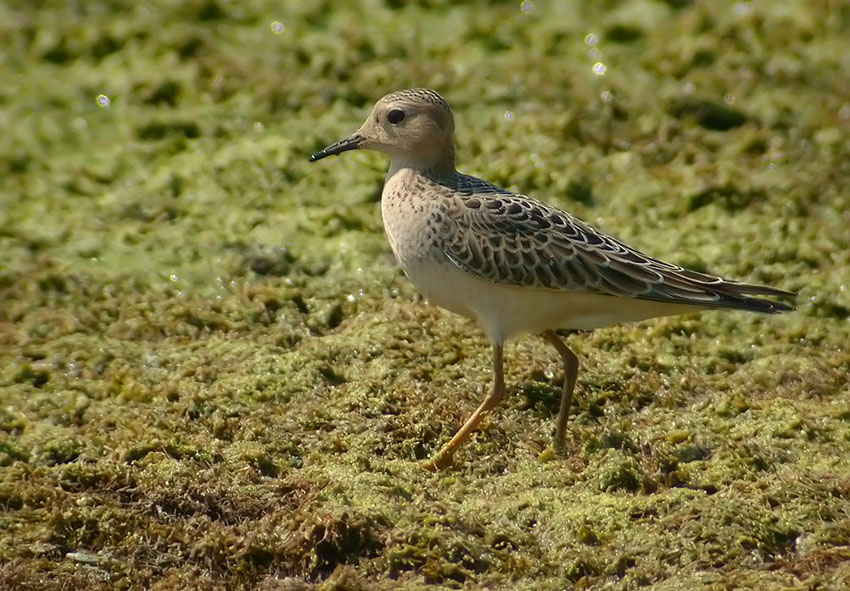
Two of my colleagues from Eagle Optics finally got to see a BUFF-BREASTED SANDPIPER at Horicon National Wildlife Refuge. Katie Fitzmier and Valerie Langlois had the day off work yesterday with perfect weather for a road trip. From the report Katie gave me over her cell phone on their way back it sounded like many of the shorebirds that were there on Saturday have already moved on, but they still saw lots of fun birds and had a great time.

A few weeks ago Katie missed a Buff-breasted Sandpiper by only 15 minutes at the V-Pond north of Waunakee. I called her on Jesse's cell phone and said, "Katie, guess what I'm looking at RIGHT NOW through my spotting scope?" Shortly after I hung up, a Cooper's Hawk flew over the pond scaring up all the shorebirds! The Buff-breasted Sandpiper remained but skittishly bobbed on its legs. It was all too much for the sandpiper...it took off and headed out for good.

Anyway, congratulations to Katie and Val on the life bird Buff-breasted Sandpiper!

Buff-breasted Sandpiper © 2005 Michael Allen McDowell

8.23.2005

Species hotspots hard to pin down


Study finds little overlap between hotspots based on different types of biodiversity.

"A global survey of birds has revealed how hard it can be to identify 'hotspots' of species diversity that need to be protected. The mapped distribution of 9,500 bird species shows that there are major differences between hotspots based on three different types of biodiversity; it all depends on whether you refer to areas rich in species diversity in general, threatened species specifically, or endemic species, which have a limited habitat."

Link: Full Article from Nature.com

Birders took a toll on Owls?


Editorial/Opinion

There is a disappointing article in the autumn 2005 issue of The Nature Conservancy magazine about the 2004/2005 northern owl irruption. The Sightings column paragraph titled "The Year of the Owl - Birders get Northern Owl Exposure" by science writer Christine Mlot states, "The roads and cars that brought in droves of birders took a toll on the owls." While there is no doubt in my mind that there was increased automobile traffic due to birders driving up to northern Wisconsin and Minnesota wanting to glimpse the boreal owls, I doubt they're to blame to the extent this sentence seems to imply.

I don't even know of a rumor of a birder having struck an owl with their car. I realize that this doesn't make it a fact, but when birders are birding via automobile through an area where owls have been reported, their cars are relatively easy to spot. They're the ones driving about 10 to 20MPH along the side of the road. While this behavior probably earned a few angry fingers, if you want to point the "blame finger" at a group of people for owl deaths, then you should do so at people who drive excessively faster than posted speed limits.

While starvation was a cause of death for many of these owls, far more were in fact killed due to collisions with automobiles. However, I disagree with Mlot's sentiment that it was birders who took a toll on the owls. When I was in the Superior area last December with a couple of other birders, whenever we saw an owl ahead along the road we pulled over and waited for it to move on before driving off. Naturally, I can't speak for all birders out there, but I'm willing to bet their birding ethics, behavior and experiences in the field in the vast majority of cases were much like my own.

Birders are looking for the owls. I doubt other non-birder drivers even care. How's that for a hasty generalization?

Link: All about the Great Gray Owl from Cornell Labs

Great Gray Owl image © 2005 Michael Allen McDowell

Digiscoping Tip: Shooting Perspective


(click on image for larger version)

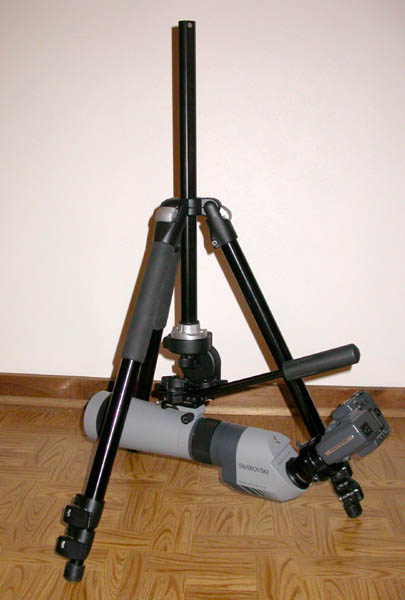
An effective way to enhance your bird digiscoping (especially for shorebirds and waders) is to consider the perspective of the bird by lowering your tripod and reducing your shooting angle. The tripod I presently use is a Bogen 3021BN tripod, which comes with a removable center post like many of their other tripod models have. Ever wonder what that triangular stop with the 3/8" bolt at the bottom of the post is for?


Bogen probably has a name for it, but I call it the center post adapter. It can be removed from the post and then used in place of it by threading it directly to the bottom of a Bogen 3130 head. By shortening the two rear legs and extending the front one for stability, you can reduce your shooting angle by more than half:


Before I bought the 3021BN I used the 3011BN tripod which didn't include a center post adapter. Nevertheless, you can still remove the center post, flip the entire thing over and re-insert it upside-down. Then all you have to do is use the rotation-release knob on the side of the spotting scope to turn it 180 degrees so your camera is accessible:


(click on image for full view of configuration)

While this configuration can give you an incredibly low shooting angle with stability, your horizontal angle is restricted because the legs get in the way of the objective side of the scope. For even an even lower angle, there are situations when I've removed the entire spotting scope from the tripod and belly-crawl up to the edge of a pond and poke the objective lens slowly through the cattails ala Arthur Morris style. This method was used for the American Golden Plover shot from yesterday's blog entry. Of course, you have to have really good light and have fast shutter speeds for this technique to yield good results. Which is another reason why I strongly recommend a digital camera that has aperture priority so you can see what your shutter speed is.

While Arthur's book The Art of Bird Photography is written for SLR photography, there are lots of tips that can apply to digiscoping. Shorebirds and waders are among of my most favorite bird subjects. It's not always possible to use the above techniques, but you can take a look at my gallery and probably guess which shots I employed these various methods.

All images © 2005 Michael Allen McDowell

8.22.2005

Shorebirds and more shorebirds!


(click on image for larger version)

Jesse Peterson and I spent the better part of Saturday watching shorebirds at Horicon National Wildlife Refuge. In the morning there were large, skittish flocks comprised of LEAST SANDPIPERS, SEMIPALMATED SANDPIPERS and PECTORAL SANDPIPERS. It's so cool watching flocks of shorebirds zoom around and turn in unison. Most of the time it seemed to be a couple of NORTHERN HARRIERS that kept the shorebirds taking to the air, but apparently some birders witnessed a young PEREGRINE FALCON carrying off a peep in its talons.

Both LESSER and GREATER YELLLOWLEGS were present as well as a few STILT SANDPIPERS and several SHORT-BILLED DOWITCHERS. Also seen were SANDERLINGS, SOLITARY SANDPIPERS, SPOTTED SANDPIPERS,SEMIPALMATED PLOVERS, KILLDEER and WILSON'S SNIPE. BAIRD'S SANDPIPERS were numerous with really great views.

On a tip from birders Tom & Carol Sykes we observed 2 BUFF-BREASTED SANDPIPERS along the west section of Old Marsh Road. These were a lifer for a birder named Sam from Massachusetts who came along with Jesse and I. Another birder reported BLACK-BELLIED PLOVERS near this same location but they were not present by the time we got there.

With all of this there were so many other birds there worth enjoying like AMERICAN WHITE PELICANS, BLACK TERNS, SNOWY EGRET, BLACK-CROWNED NIGHT HERONS and all the GREAT EGRETS. The place is just decorated with birds right now.

On Friday there were two AMERICAN GOLDEN PLOVERS at the V-Pond north of Waunakee, but the pond is quickly drying up and probably won't be good stop-over habitat for much longer.

Here's a nice picture of a Buff-breasted Sandpiper digiscoped by Tom Prestby at the Rainbow Flowage. Tom uses a Swarovski ATS 80 HD spotting scope with a Nikon Coolpix 4500, and for more of his digiscoping, you can visit his Webshots site.

American Golden Plover image © 2005 Michael Allen McDowell

8.20.2005

Field Trip - Early Fall Migrants


Some birders in southern Wisconsin have already reported a few southbound warbler species. NexRad radar has also been showing increased migration activity during the night for the past week and will reach its peak sometime after Labor Day. Are you in the Madison area? The first fall field trip I'll be leading is for the Madison Audubon Society on Saturday, August 27th at Pheasant Branch Conservancy. We can expect to see warblers, vireos, flycatchers and other early fall migrants. The trip will last approximately two hours, so bring comfortable shoes for walking/hiking. Meet at 7:00 a.m. in Middleton at the Branch Street Retreat bar parking lot at the corner of Century Avenue and Branch Street. I'll bring a few extra pair of binoculars for those who need them!

This field trip is free and open to the general public!

Palm Warbler image © 2005 Michael Allen McDowell